In the misty dawn of autumn, when the first chills begin to creep into the air across regions like Périgord in France and the countryside of Piedmont in Italy, a centuries-old tradition awakens. This is the start of the black truffle hunting season, a period shrouded in as much mystery and romance as the prized fungus itself. Known as the black diamond of the culinary world, the black truffle (Tuber melanosporum) commands astronomical prices and unparalleled reverence among chefs and gourmands. Yet, the true heroes of this elusive harvest are not the humans who covet it, but the specially trained dogs whose noses unlock the treasures hidden beneath the earth.
The art of truffle hunting has evolved dramatically over the centuries. Historically, pigs were the hunters of choice, their natural instinct to root for truffles driven by a compound in the fungus that mimics a sex pheromone found in boar saliva. However, pigs presented a significant problem: they loved to eat the truffles they found. This, combined with their size and the difficulty of transporting them, led hunters to seek a more manageable and less indulgent partner. Thus began the era of the truffle dog.
Training a dog for truffle hunting is a delicate process that blends patience, instinct, and a deep bond between the animal and its handler, known as a tartufaio. It begins not in the forest, but at home. The selection of the dog is the first critical step. While certain breeds like the Lagotto Romagnolo—a curly-coated Italian water dog—are renowned for their innate scenting abilities and historical association with truffling, a successful truffle dog is not defined by pedigree alone. Intelligence, a strong play drive, and a keen nose are the true prerequisites. Many a talented truffle hound is a humble mutt, rescued from a shelter and gifted a purpose.
The foundation of all training is positive reinforcement. The dog must not view the truffle as food, but as the ultimate toy, the key to its favorite game. Trainers start by imbuing a specific scent with immense value. This often begins with a cotton ball soaked in truffle oil or a small piece of low-grade truffle sealed inside a perforated container. The container is used as a fetch toy. The dog learns that finding this scent and indicating its location—usually by sitting or scratching gently at the ground—results in an ecstatic celebration from its human and a reward of a favorite treat or a session of play with a beloved ball.
As the dog masters this indoor game, the training moves to controlled outdoor environments. The trainer will hide the scented object in increasingly challenging locations: under a light layer of leaves, buried in a shallow hole in the garden, or at the base of a tree. The dog is taught to ignore other distractions—the scent of a rabbit, a passing squirrel, the rich aroma of the forest floor—and focus solely on the target odor. This phase is where the bond is solidified. The dog works for the joy of working with its handler, a partnership built on mutual trust and excitement.
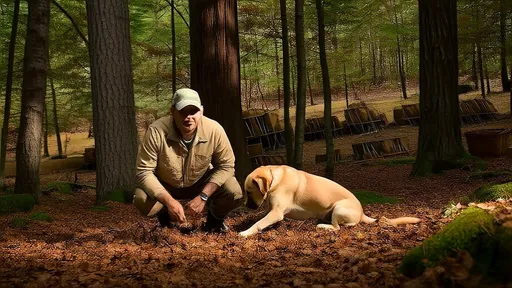
The relationship between a tartufaio and their dog is profoundly symbiotic. The hunter must be an expert reader of the land, understanding the complex symbiosis between the truffle and its host trees, typically oaks, hazels, and poplars. They know to look for the brûlé, a burnt-looking patch of earth around the base of the tree where the truffle’s mycelium has killed the surrounding grass. But without the dog’s nose, this knowledge is nearly useless. The truffle emits its potent aroma only when it is fully ripe, and it can lie as deep as a foot below the surface, completely invisible. The dog’s olfactory capabilities, which are between 10,000 to 100,000 times more sensitive than a human’s, are the only tool precise enough to pinpoint the exact location of maturity without disturbing the delicate ground and damaging the precious mycelium network for future seasons.
A successful hunt is a silent ballet of communication. The dog, unleashed, zigzags through the woodland, nose to the wind and then to the ground. The hunter watches for the subtlest change in the animal’s posture—a quickening of pace, a deepening of sniffing, a focused pause. When the dog signals, the hunter approaches quietly. With painstaking care, using a special narrow spade, the hunter excavates the truffle, often rewarding the dog immediately to maintain the positive association. The hole is then carefully refilled and moistened to protect the mycelium, ensuring the continuation of the fungal colony. This sustainable practice is a sacred rule among ethical truffle hunters.
The challenges facing modern truffle hunting are immense. Climate change, with its unpredictable weather patterns and droughts, threatens the delicate ecosystems truffles require. Deforestation and urban sprawl are encroaching on traditional hunting grounds. Perhaps most insidiously, the soaring value of truffles has led to theft and sabotage, with some hunters poisoning rivals' dogs or stealing well-trained animals. Many tartufai now operate in secrecy, guarding the locations of their most productive trees with their lives and often hunting under the cover of darkness.
Despite these pressures, the tradition endures, passed down through generations. It represents more than just a means to a lucrative end; it is a cultural heritage, a connection to the land, and a testament to the unique partnership between human and animal. The truffle dog is more than a tool; it is a companion and colleague, whose joy in the hunt is as pure as the coveted aroma of the black diamond it finds.
In the end, the journey from the damp soil to the dazzling plates of Michelin-starred restaurants is a story of ancient wisdom, unwavering dedication, and a nose that knows. The black truffle remains a symbol of nature’s hidden magic, and the dogs are the faithful guides who, season after season, continue to reveal its secrets.

By /Aug 29, 2025
By /Aug 29, 2025
By /Aug 29, 2025
By /Aug 29, 2025

By /Aug 29, 2025
By /Aug 29, 2025
By /Aug 29, 2025

By /Aug 29, 2025
By /Aug 29, 2025
By /Aug 29, 2025
By /Aug 29, 2025
By /Aug 29, 2025
By /Aug 29, 2025
By /Aug 29, 2025
By /Aug 29, 2025
By /Aug 29, 2025
By /Aug 29, 2025
By /Aug 29, 2025
By /Aug 29, 2025
By /Aug 29, 2025
