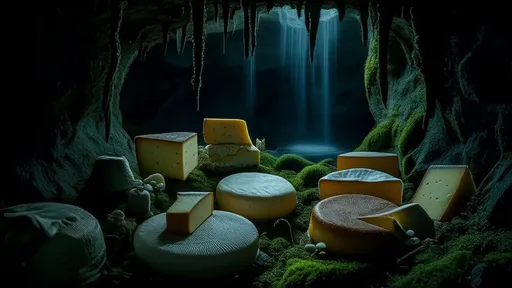
Deep beneath the rolling hills of Roquefort, in the cool, damp caves of Combalou, a silent transformation is underway. Wheels of cheese rest on wooden shelves, their surfaces blooming with blue-green mold as they absorb the distinct mineral breath of the earth. This is not mere storage; it is an act of co-creation. The flavor of Roquefort, with its sharp tang and creamy, pungent finish, is not solely the product of milk, rennet, or a cheesemaker’s skill. It is, in large part, a gift from the cave itself—a complex offering delivered by an invisible world of environmental microbes.
The concept of terroir, long used to describe how a vineyard’s specific environment imprints itself on a wine, is equally vital to the world of artisan cheese. A cheese’s final character is a narrative written by its environment. The air circulating through a stone crevice, the humidity clinging to the walls, and the very microbial residents that call the cave home all contribute to a unique biochemical signature. These microscopic actors—fungi, bacteria, and yeasts—settle on the cheese’s rind and penetrate its paste, initiating a slow, deliberate dance of fermentation and enzymatic breakdown that defines its texture, aroma, and most importantly, its flavor profile.
For centuries, this process was shrouded in mystery and tradition, a form of alchemy passed down through generations. Cheesemakers knew that certain caves produced superior cheese, but the why remained elusive. They were unknowingly curating a microbiome, a complete ecological community of microorganisms. Today, modern science is peering into this microbial world, using DNA sequencing and mass spectrometry to map the incredible diversity of species present in these aging environments. The findings are revolutionizing our understanding of cheese, revealing that the cave is not a passive cellar but a living, breathing ecosystem that actively participates in the cheesemaking process.
Take, for instance, the famous limestone caves of Roquefort-sur-Soulzon. Their unique geology creates a system of natural ventilation known as fleurines—deep fissures that allow fresh air to circulate while maintaining a constant, high humidity and a chilling temperature perfect for aging. This stable climate is only half the story. The walls of these caves are coated with a permanent biofilm of Penicillium roqueforti spores. As the cheese ages, this native mold drifts onto the surface and is manually introduced by piecing the curd, creating the iconic blue veins. The mold’s metabolic activity is what produces the complex array of methyl ketones, alcohols, and esters responsible for Roquefort’s peppery, savory, and slightly spicy notes. A wheel aged elsewhere with a lab-cultured strain of the same mold would taste entirely different; it would lack the nuanced symphony of other wild microbes that call the Combalou caves home.
Similarly, in the humid, warm tuffeau caves of the Loire Valley, the story is written by yeast and bacteria. Here, the rinds of goat’s milk cheeses like Sainte-Maure de Touraine develop a wrinkled, bloomy coating of Geotrichum candidum and Penicillium camemberti. But the environment contributes its own cast of characters. Ambient yeasts, such as Debaryomyces hansenii, thrive in the salty, acidic surface of the young cheese, consuming lactic acid and raising the pH. This creates a favorable frontier for the delicate, velvety white mold (P. camemberti) to establish itself. The result is a cheese with a distinctive mushroomy, grassy, and slightly ammoniacal flavor that is the direct result of this specific microbial succession, a process dictated by the cave’s unique atmospheric conditions.
The impact of these environmental microbes is not limited to the rind. Their enzymatic power reaches deep into the cheese’s core. Proteolysis, the breakdown of proteins, and lipolysis, the breakdown of fats, are the two primary engines of flavor development. Molds and bacteria secrete a cocktail of enzymes that chop long, bland protein chains and fat molecules into shorter, volatile compounds. These compounds are the very essence of flavor. Short-chain free fatty acids like butyric and caproic acid provide sharp, pungent, and goat-like notes. Amino acids contribute to savory, umami, and sweet tastes. The specific balance of these compounds—which ones are produced and in what quantity—is directly influenced by the particular consortium of microbes present. A cave with a different microbial fingerprint will guide these reactions down a different chemical pathway, yielding a completely different-tasting cheese from the same initial curd.
This profound connection presents both a challenge and an opportunity for modern cheesemakers. The industrialization of food production led many to abandon natural caves in favor of sterile, temperature-controlled aging rooms. While this ensures consistency and safety, it often comes at the cost of complexity and gout du terroir—the taste of the place. A cheese aged in a stainless-steel room inoculated with a single, lab-produced strain will be predictable, but it may lack the depth and layered nuance of its cave-aged counterpart.
Recognizing this, a growing movement of affineurs and artisan producers is returning to traditional methods, not out of nostalgia, but out of a desire for superior flavor. They are championing the role of the natural cave microbiome. Some are even taking it a step further by practicing what could be called "microbial farming." They are mapping the microbial ecosystems of their aging facilities and actively cultivating them, much like a gardener tends a plot of land. They might introduce old wooden shelves that harbor beneficial molds or brush young cheeses with a solution containing a complex culture harvested from their best-aged wheels, effectively seeding the environment with a desired microbial community.
The implications extend beyond tradition. Research into these complex microbial interactions is providing new tools for the industry. Scientists are working to define the "core microbiome" of renowned aging caves, identifying the key microbial players responsible for desirable flavors and those that might lead to defects. This knowledge could help producers better manage their environments, promoting the growth of beneficial species and suppressing harmful ones, all while preserving the unique regional characteristics that make artisan cheese so captivating.
In the end, a great cheese is a landscape expressed in a flavor. It is a testament to the milk, the animal, the maker, and the land. But it is also a portrait of a hidden world. The musty air of the cave, the ancient stone, and the timeless microbial residents are all co-authors of the final product. Each bite of a truly cave-aged cheese is a taste of a specific place and its invisible inhabitants—a remarkable collaboration between human artistry and the ancient, silent, and delicious work of environmental microbes.

By /Aug 29, 2025

By /Aug 29, 2025
By /Aug 29, 2025
By /Aug 29, 2025

By /Aug 29, 2025

By /Aug 29, 2025

By /Aug 29, 2025

By /Aug 29, 2025
By /Aug 29, 2025
By /Aug 29, 2025
By /Aug 29, 2025
By /Aug 29, 2025
By /Aug 29, 2025

By /Aug 29, 2025
By /Aug 29, 2025
By /Aug 29, 2025
By /Aug 29, 2025
By /Aug 29, 2025
By /Aug 29, 2025
By /Aug 29, 2025
