In the heart of the monsoon season, when the skies weep relentlessly and the city's veins swell with rainwater, an unusual postal service emerges from the depths. Known as the Paper Boat Post Office, this ephemeral operation transforms the often-dreaded urban waterways into channels of human connection, carrying handwritten messages on delicate paper vessels through the labyrinthine sewers systems. It is a testament to the resilience of human spirit and the poetic interplay between nature's forces and urban life.
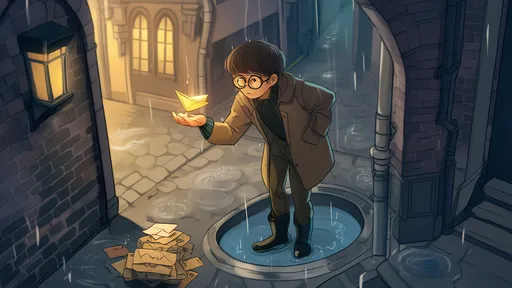
The concept was born from a local artist's whimsical experiment a decade ago, inspired by childhood memories of sailing paper boats in puddles. During a particularly heavy downpour, she folded a letter into a boat and released it into a storm drain, half-expecting it to dissolve instantly. To her astonishment, a neighbor downstream found it days later, slightly weathered but legible, and responded via the same unconventional method. This serendipitous exchange sparked a grassroots movement that now sees hundreds of participants each rainy season, turning the city's drainage network into an ad-hoc communication web.
Operated entirely by volunteers, the Paper Boat Post Office functions on a simple yet profound principle: messages are written on water-resistant, biodegradable paper, folded into origami boats, and deposited at designated "mailboxes"—marked grates and overflow points along the sewers. The currents act as postal workers, ferrying these flotillas of hope, confession, or camaraderie through dark tunnels until they are caught by nets or retrieved by recipients stationed downstream. Some letters travel mere blocks; others journey for miles, their paths dictated by the capricious flow of rainwater.
What sets this practice apart is its raw authenticity. In an age dominated by digital immediacy, the Paper Boat Post Office demands patience and faith. There are no tracking numbers or delivery guarantees—only the trust that a stranger might find and cherish your words. Messages range from heartfelt apologies and secret admirations to philosophical musings and collaborative stories continued by multiple hands. Each boat becomes a tiny time capsule, embracing the imperfections of smudged ink and water-stained edges as part of its charm.
The environmental consciousness embedded in the initiative is equally remarkable. Volunteers use plant-based inks and paper derived from sustainable sources to minimize ecological impact. After retrieval, messages are often displayed in pop-up galleries or compiled into zines, celebrating the temporary art born from rainfall. This transient nature mirrors the monsoon itself—here for a season, then gone, leaving only memories and perhaps a few dried paper remnants as proof of its existence.
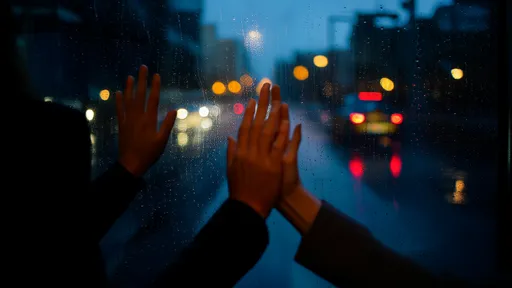
Critics might dismiss it as a romanticized folly, but participants argue it redefines urban infrastructure as something living and responsive. The sewers, typically associated with waste and neglect, becomes a conduit for emotion and creativity. It challenges perceptions of what a city can be—not just concrete and steel, but a organism capable of fostering unexpected beauty. During the monsoon, children press their faces against windows not with dread, but with excitement, wondering what messages the rain might bring.
Local authorities initially viewed the practice with skepticism, concerned about blockages or safety hazards. However, after years of incident-free operation and growing positive media attention, they have adopted a stance of bemused tolerance. Some even secretly participate, dropping their own folded confessions into the flow after hours. The Paper Boat Post Office has unwittingly become a symbol of gentle rebellion against urban alienation, proving that even in the most engineered environments, nature and humanity can collaborate to create magic.
As climate change alters rainfall patterns, volunteers note that the "postal seasons" have become less predictable, sometimes arriving earlier or lasting longer. This has inspired discussions about adapting the practice—perhaps using more durable materials or expanding to other cities facing similar seasonal transformations. Yet many purists insist on preserving its fragility; the risk of dissolution is what makes each message precious.
In the end, the Paper Boat Post Office is more than a quirky hobby—it is a meditation on temporality, community, and the art of letting go. It reminds us that not all connections need to be instant or permanent to be meaningful. Sometimes, the most profound words are those entrusted to the rain, sailing through the dark on a paper boat, waiting to be found by someone who needs them exactly when they arrive.
By /Aug 27, 2025

By /Aug 27, 2025
By /Aug 27, 2025

By /Aug 27, 2025
By /Aug 27, 2025

By /Aug 27, 2025

By /Aug 27, 2025
By /Aug 27, 2025

By /Aug 27, 2025
By /Aug 27, 2025
By /Aug 27, 2025

By /Aug 27, 2025

By /Aug 27, 2025
By /Aug 27, 2025
By /Aug 27, 2025
By /Aug 27, 2025
By /Aug 27, 2025
By /Aug 27, 2025
By /Aug 27, 2025
By /Aug 27, 2025
