The world of mechanical keyboards has evolved far beyond the simple binary actuation of membrane switches, entering a realm where every millimeter of travel and every gram of force is meticulously measured, debated, and engineered. At the heart of this precision-driven community lies a concept both fundamental and profoundly complex: the force curve. It is the graphical representation of a switch's soul, a plot that tells the story of every keypress from the initial resting state to the satisfying bottom-out and the eventual return. For decades, enthusiasts and manufacturers alike have treated these curves as a near-sacred text, a predetermined gospel handed down by switch designers. However, a quiet revolution is brewing, moving beyond mere selection of pre-made switches and into the active, algorithmic optimization of the trigger curve itself.
The traditional approach to switch selection has been a game of compromise. A user seeking a tactile bump might choose a Cherry MX Brown, accepting its relatively mild tactility and potential for hysteresis. A gamer might opt for a linear Red switch, sacrificing all feedback for sheer speed. The force curve for each of these switches was a fixed, immutable property. You bought the switch, and you lived with its characteristics. The emerging paradigm flips this model on its head. Instead of asking, "Which pre-defined curve is the least bad fit for my needs?" engineers and hobbyists are now asking, "How can I create the perfect curve for my specific application?" This shift is powered by a deeper understanding of switch mechanics, advanced materials, and sophisticated firmware.
Deconstructing a switch's force curve reveals a narrative of physical interactions. The initial pre-travel is a story of spring compression, governed by Hooke's law, where force increases linearly with displacement. Then comes the event—the moment of truth. In a tactile switch, this is the dramatic climax: the tactile bump. This is caused by the slider leg interacting with the metal leaf spring inside the switch housing. The leg must overcome the leaf's resistance, causing a sharp spike in force before it slides over the apex, resulting in a sudden drop (the tactile collapse) and the subsequent actuation. In a clicky switch, a separate plastic jacket creates a similar resistance spike but releases with an audible 'click'.- A linear switch, by contrast, lacks this dramatic event, presenting a smooth, uninterrupted curve. The final phase, post-actuation travel to the bottom, is again primarily a function of the spring, often with a slight non-linearity as the spring coils begin to compress against each other.
The quest for optimization targets every segment of this narrative. For the spring-dominated sections, the variables are spring length, wire diameter, and material. A longer, thinner spring made of a specific alloy will produce a gentler, more progressive slope. A shorter, thicker spring creates a steeper, heavier curve. But the holy grail lies in manipulating the event point. Custom leaf spring designs, manufactured with precision tolerances, can alter the sharpness, height, and location of the tactile bump. A sharper, more pronounced bump provides a clearer confirmation of actuation, highly desired by typists. A smoother, more rounded bump can reduce fatigue during long sessions. The placement of the bump relative to the actuation point is also critical; a bump that occurs precisely at actuation provides immediate feedback, while one that happens just before can serve as a warning, preparing the finger for the imminent register of the keystroke.
Material science plays a pivotal role in this new era of customization. The traditional gold-plated copper alloy leaf springs are being challenged by new composites and treatments that offer better fatigue resistance and more consistent force profiles over millions of keypresses. Lubricants, once applied haphazardly to dampen sound, are now used with surgical precision to alter the friction coefficients between the slider and the housing, directly smoothing out the curve's transitions. The viscosity, composition, and application points of these lubricants are all variables in the optimization equation. Even the plastic used for the slider and housing is under scrutiny. Different polymer blends exhibit different coefficients of friction and wear properties, subtly changing the feel and the resulting force curve over the switch's lifespan.
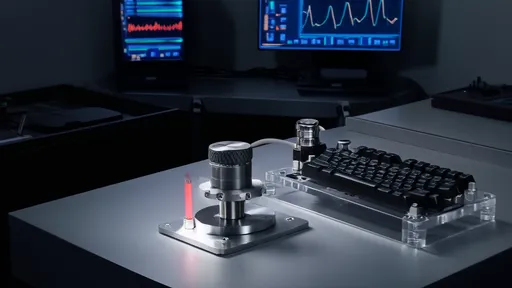
However, the most groundbreaking development is the move from passive mechanical optimization to active electronic intervention. This is where firmware and dynamic actuation point adjustment enter the picture. High-end keyboard PCBs are now capable of polling key positions at extremely high rates, thousands of times per second. This raw data stream of key travel distance is fed into algorithms that can dynamically interpret the force curve in real-time. A user could, through software, define their own ideal actuation point anywhere along the key's travel. Want to actuate a key after only 0.5mm of press, making it hyper-sensitive for gaming? The firmware can be configured to do so. Prefer a deeper, 3.5mm press for deliberate typing to avoid errors? That too can be set. This software layer effectively decouples the physical actuation mechanism of the switch from the logical actuation command sent to the computer.
This firmware-driven approach allows for even more sophisticated manipulations. Imagine a "smart curve" that adapts to your typing style. The algorithm could learn your average bottom-out force and automatically adjust the actuation point to ensure it always registers before you smash the key, protecting your fingers from strain. It could create a "soft landing" effect by altering the input response near the bottom of the keystroke, effectively simulating a dampener. For tactile switches, the firmware could be programmed to recognize the signature force drop of the tactile collapse and send the actuation signal at that exact moment, creating a perfectly synchronized feel that is impossible to achieve with mechanical components alone due to manufacturing tolerances.
The implications of this trend extend far beyond the niche community of keyboard enthusiasts. In the realm of accessibility, customizable force curves are a game-changer. Individuals with motor control limitations, arthritis, or muscle weakness can tailor a keyboard to require minimal actuation force, or create a curve with a very pronounced and early tactile bump to provide clear confirmation with little effort. Conversely, users prone to accidental keypresses can implement a curve with a significant initial force barrier. In professional environments, data entry clerks could optimize switches for speed and reduced fatigue, while programmers might prefer a sharp, distinct actuation point to maintain flow state without bottoming out. The one-size-fits-all model of keyboard input is rapidly becoming obsolete.
Of course, this new frontier is not without its challenges and critiques. Purists argue that software-adjusted actuation points create a disconnect between the physical feel and the electronic response, leading to a potentially unnatural or mushy experience. There are significant technical hurdles in achieving perfect, jitter-free analog measurement of key travel on every switch of a full-sized keyboard reliably and affordably. Furthermore, the complexity of designing and tuning these systems raises the barrier to entry, potentially alienating casual users and focusing development on expensive, high-end products. The quest for the perfect curve could become an endless cycle of micro-optimization, a paralysis by analysis where the user is forever tweaking settings instead of actually using their keyboard.
Despite these challenges, the trajectory is clear. The future of mechanical keyboard switches is not merely in a wider selection of colors and spring weights, but in the deep, granular customization of their most fundamental characteristic: the force curve. We are moving from an era of selection into an era of creation. The keyboard is transforming from a static input device into a dynamic interface, its behavior malleable and personal. The click-clack of the switch will remain, but the intelligence behind it is growing quieter, smarter, and infinitely more adaptable. The optimization of the trigger curve represents the final, deepest level of personalization, where the hardware and software converge to create a truly bespoke typing experience tailored to the individual's finger, their task, and their desire for perfection.

By /Aug 27, 2025

By /Aug 27, 2025

By /Aug 27, 2025

By /Aug 27, 2025

By /Aug 27, 2025

By /Aug 27, 2025

By /Aug 27, 2025

By /Aug 27, 2025

By /Aug 27, 2025
By /Aug 27, 2025
By /Aug 27, 2025
By /Aug 27, 2025
By /Aug 27, 2025

By /Aug 27, 2025

By /Aug 27, 2025

By /Aug 27, 2025
By /Aug 27, 2025
By /Aug 27, 2025
By /Aug 27, 2025
By /Aug 27, 2025
