In the silent, frigid embrace of polar nights and high-altitude clouds, a delicate architectural marvel unfolds, largely unseen by human eyes. The formation of ice window crystals, those intricate and often breathtaking structures that adorn cold surfaces, represents one of nature's most exquisite examples of spontaneous design. Recent interdisciplinary research has begun to peel back the layers of this complex process, revealing a world where temperature, humidity, and molecular physics engage in a subtle dance to create transient beauty.
The very term sublimation often evokes images of a solid turning directly into a gas, but its reverse process—deposition, where water vapor transitions immediately into solid ice—is the fundamental mechanism behind these crystalline formations. Unlike freezing, which involves liquid water turning to ice, deposition occurs in environments so cold that the liquid phase is entirely bypassed. This direct gas-to-solid transition allows for the creation of structures with a purity and complexity that frozen water droplets cannot achieve.
Dr. Alina Petrova, a leading materials scientist at the Institute for Low-Temperature Studies, emphasizes the unique conditions required. "The window is not merely a cold surface; it acts as a catalyst and a canvas," she explains. "Its temperature must be significantly below the freezing point of water, but crucially, it must also be colder than the surrounding air. This creates a steep gradient in water vapor pressure, drawing molecules to the surface where they surrender their kinetic energy and lock into a rigid, crystalline lattice."
The initial stage of growth is a nucleation event, a precarious beginning where a few water molecules, slowed by the intense cold, chance upon a microscopic imperfection on the glass—a speck of dust, a tiny scratch, or even a residue from cleaning. These sites break the symmetry of the surface, providing a necessary anchor for the first ice bonds to form. Without these nucleation points, the supercooled vapor might simply flow past the glass without depositing. This initial cluster, once stable, becomes a template, dictating the orientation and, to a large extent, the final morphology of the growing crystal.
The architecture of the resulting crystal is a direct testament to the ambient conditions during its growth. The two most critical variables are temperature and supersaturation—the amount of water vapor present relative to the maximum amount the air can hold at that temperature. At very low temperatures and moderate supersaturation, the growth is slow and diffusion-limited. Molecules have little energy to move far from their landing site, leading to solid, often hexagonal, plates or compact columns. These are the classic, simple snowflake shapes many are familiar with.
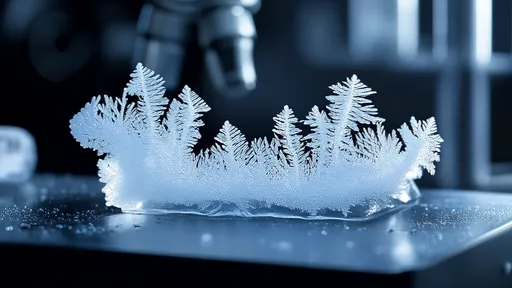
However, as the temperature inches slightly higher (while still being well below freezing) and the air becomes rich with excess vapor, the process enters a realm of extraordinary complexity. The high supersaturation provides a surplus of building blocks, while the marginally warmer conditions allow molecules more surface mobility upon deposition. They can diffuse along the crystal's face, seeking the most energetically favorable positions—typically the corners and edges. This preferential growth at the extremities leads to the instigation of branches. Any minor fluctuation in temperature or humidity amplifies these branches, and as the crystal tumbles through different micro-environments in a cloud, or experiences changing conditions on a static windowpane, each branch develops its own unique pattern of side-branches and facets. This is why no two complex crystals are ever truly identical; each is a frozen diary of its own growth history.
The role of the substrate itself—the window glass—is profound and often overlooked. Its chemical composition, surface energy, and nanoscale topography are silent partners in the crystallization process. A perfectly clean, smooth pane of glass might resist nucleation, resulting in a clear, frost-free surface until conditions become extreme. Conversely, a window with microscopic contaminants or scratches becomes a fertile ground for frost, blooming with crystals at higher temperatures. Modern materials science is even exploring engineered surfaces with specific coatings designed to either inhibit frost formation for energy efficiency or promote it in controlled, decorative ways.
Beyond their aesthetic appeal, the study of ice window crystals holds significant practical importance. The process of frost deposition is a major concern in aerospace engineering, where ice accumulation on aircraft wings and sensors can be catastrophic. Understanding the precise mechanics of how, when, and where ice crystals form allows engineers to develop more effective anti-icing and de-icing systems. Similarly, in the HVAC and refrigeration industries, frost buildup on heat exchanger coils drastically reduces efficiency. Research into the fundamental physics of deposition is leading to smarter, surface-based technologies that can delay frost formation or make its removal easier, yielding substantial energy savings.
Furthermore, this phenomenon is not confined to our planet. The study of water vapor deposition is crucial for modeling the weather and climate of Mars, where atmospheric water vapor directly forms ice clouds and surface frost. The patterns observed on a winter windowpane here on Earth inform the algorithms scientists use to interpret remote sensing data from rovers and orbiters millions of miles away, helping to paint a picture of the water cycle on another world.
In the end, the frost on a window is far more than a sign of winter's chill. It is a dynamic, physical manifestation of a delicate balance in our atmosphere. It is a demonstration of fundamental physical laws written in a language of crystal and light. The next time you find yourself tracing the patterns on a frosty pane, remember that you are looking at a unique and ephemeral artwork, sculpted not by chance, but by the immutable and elegant laws of physics. Each feathery fern, each spiky star, is a record of a journey—a story of water vapor traversing the air to join a growing lattice, forever capturing a specific moment of cold, stillness, and perfect natural order.

By /Aug 27, 2025

By /Aug 27, 2025
By /Aug 27, 2025
By /Aug 27, 2025

By /Aug 27, 2025
By /Aug 27, 2025

By /Aug 27, 2025
By /Aug 27, 2025

By /Aug 27, 2025
By /Aug 27, 2025
By /Aug 27, 2025
By /Aug 27, 2025

By /Aug 27, 2025
By /Aug 27, 2025
By /Aug 27, 2025

By /Aug 27, 2025
By /Aug 27, 2025
By /Aug 27, 2025
By /Aug 27, 2025

By /Aug 27, 2025
